
The invisible cost of brand inconsistency

Blanca Ruíz, Brand Alchemist
BRS Branding Studio www.brsbranding.com
Brand and Identity Design, Brand Consultant
Nobody talks about what it actually costs. They call it a learning curve instead.
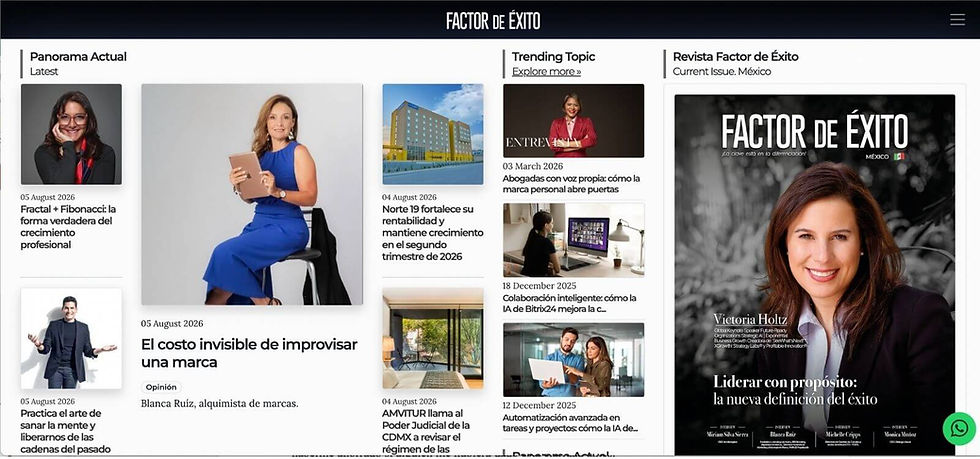
I want to talk about the money you're losing right now. I originally wrote this for Revista Factor de Éxito in Spanish. Sharing the English version here too.
Is a good logo the same as an effective brand?
No. Let's clear that up first. A good logo isn't the same thing as an effective brand. Without strategy, that's all it is: a good logo.
I know because I paid for this lesson myself. When your strategy isn't dialed in, you fall into a loop of trial and error that feels like progress, but it's really just motion. And that loop has a price. It's a big part of why I do what I do today, honestly. Because of the money it cost me, money I could have saved if someone had handed me this clarity sooner.
So yes, it's a real learning curve. But what if you could shrink what it's costing you?
What does brand inconsistency actually look like?
I've had clients walk in after going through three logos and three different agencies or freelancers, and none of it ever quite felt like them. Others have a total disconnect between their sales materials and their website, like each one belongs to a different company. Some are about to launch, about to sink thousands of dollars into infrastructure, and think brand is decoration you can figure out in a month. When I ask, "so how are you actually going to sell this, who are you talking to?", a lot of them don't really know.
Today, that clarity isn't optional. You need the exact language your real customers connect with, because every touchpoint, your website, your salesperson, your catalog, even the AI someone asks before they ever reach out to you, is either building that perception or tearing it down.
What does it look like when a company skips brand strategy?
One story sticks with me. A large furniture manufacturer printed 5,000 catalogs. The moment they arrived, he knew he didn't want to hand them out. Not because the printing was bad. He just held one in his hands and felt like something was missing.
Here's what was really going on: there had never been a strategy for where those catalogs fit, who they were for, what story they were supposed to tell.
5,000 pieces. Paid for. Printed. Sitting in a warehouse.
A company without a brand strategy doesn't notice it all at once. It shows up in pieces, over years:
New website every two years.
New agency.
New slogan.
New logo.
New campaigns.
New sales pitch.
Retraining the sales team, again.
Reprinting catalogs.
Wasted trade shows, because every event tells a different story.
Without a strategy, everything becomes whatever you feel like today. Two weeks later you change your mind, because you're reacting to something you saw online, something a competitor did, something someone mentioned in a meeting. Putting out fires. Stumbling forward.
Why don't companies realize this is a problem?
Because they're still selling. And if you're still selling, it's easy to assume everything is fine.
But stop for a second and ask yourself: what does it actually cost you to land each client?
How many deals do you lose on price, simply because nobody ever understood why you're worth what you charge?
Selling isn't the same as selling efficiently. You can be bringing in revenue and still be leaving money on the table without ever noticing it.
How much does it cost brand inconsistency?
That bill is measurable. A Lucidpress study on brand consistency found that companies with a misaligned identity across channels lose up to 23% in annual revenue compared to those with a unified presence. More recent industry research shows that nearly half of companies end up spending extra budget recreating marketing materials, simply because there was never a system in place to stop them from reinventing the wheel every single time.
So what's the real diagnosis?
Honestly, and it's almost funny to say it this way: those aren't the disease. They're the symptoms.
If I were a brand doctor, I'd tell you straight. Every time I walk into a new company and see those symptoms, the logos, the catalogs collecting dust, the pitch that changes depending on who's telling it, I already know the diagnosis before anyone says a word.
They need to align.
They need clarity.
They need a strategy with real, concrete steps.
And it's not enough to just align. You have to finish that strategy with steps that are realistic, doable, and specific. Because a strategy that stays on paper is the exact same problem, wearing a different name.
To learn more about how to prepare your brand for the US market, visit: brsbranding.com/branding-for-latin-american-companies-us-market
Want to know exactly where your brand stands before investing in your next stage of growth?
I created an entry-level service designed for this.
Brand Readiness Sprint:
In two weeks I tell you exactly what is ready, what has gaps, and where to start so you don't waste your investment in the new market.
The first step to building your brand in new markets.
Review of your current materials: website, social media, presentations, catalogs
Analysis of your message and digital presence
Basic interviews with potential clients in your target market
Basic mapping of your ideal client profile
Quick review of digital competition in that market
Results document: what is ready, what needs to be resolved first
A clear, actionable, and fast diagnosis to know exactly where to start.
$2,500 USD
A small investment before a big one.

Hola!
I'm Blanca Ruiz, Brand Alchemist and founder of BRS Branding Studio.
Brand strategy and visual identity for Latin American companies entering the US market and Hispanic-owned businesses that need a brand that truly represents who they are.
26 years. Bilingual. You work directly with me.
The work speaks for itself:www.brsbranding.com


Comments